What if Baby Is Teething but No Tooth Eruption
Parents Can't Handle the Tooth
Moms and dads blame teething for their infants' sleeplessness, crying, fevers, and diarrhea. They're missing the real cause.
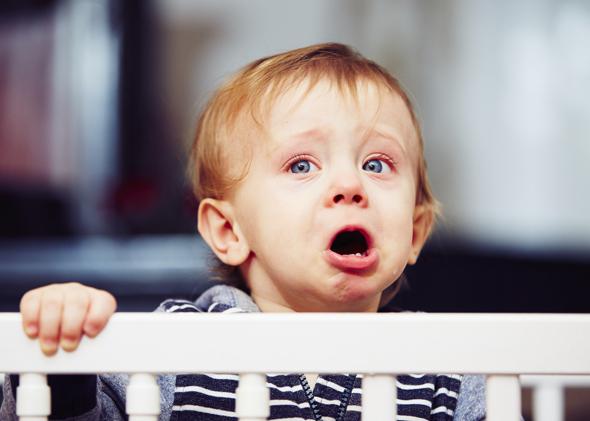
Photo courtesy of Shutterstock
When my girl was 7 months old, she abruptly stopped sleeping through the night. She was up every couple of hours, crying and enervating comfort. Teething, I thought. It was around the right fourth dimension for her first teeth to emerge. But weeks went by, and I saw no teeth, and the heart-of-the-night disruptions connected. I morphed into a mom-zombie, surviving on caffeine and chocolate.
When it came fourth dimension for me to bring her to the pediatrician for a routine visit, I described our ongoing nocturnal woes. The doctor looked at her gums. "She's non teething," he said, and she was perfectly healthy. I didn't believe him and made him check once again. I mean, she had to exist teething—at that place had to exist a existent, physiological explanation for my forced descent into the ninth circle of hell. Right? "Nope," he said. "And so what'southward going on, then?" I demanded. He smiled and replied, "It looks like she's been sleep training you lot." He was lucky to escape without a mom-zombie bite.
I've been trying to recollect of a more eloquent way to say this, just I can't, so: Teething sucks. We as parents know that teeth are going to appear, but we never know exactly when or what symptoms will precede them. Plus, babies are a roller coaster of evolving behaviors anyway, so when little Anna of a sudden becomes a train wreck, we have no idea whether it'due south considering a tooth is coming or because she's sick or because, well, she's x months former. As confused, sleep-deprived parents, nosotros desperately need explanations for our infants' foreign developments, and teething is a convenient crutch—but information technology'due south one that nosotros may rely on too frequently. The fact is that no symptom reliably predicts the eruption of a molar because babies react differently. The 1 fact experts seem to agree on—but that many parents, including myself, are reluctant to accept—is that truthful teething symptoms are generally pretty mild.
Permit'south start with the oft-cited claim that teething causes excruciating pain because a molar is "stabbing" through the gum. "That's one of those myths," explains Clay Jones, a pediatric and newborn hospitalist at Newton-Wellesley Hospital in Newton, Massachusetts, who wrote about teething for the popular weblog Science-Based Medicine. "What happens is that the gums remodel—they move out of the way as the tooth emerges." After all, Jones says, gums don't bleed when kids teethe. A 2003 written report documented a statistically significant increase in one inflammatory marker during babe teething, but the rest of the markers the study tested, chosen cytokines, didn't modify much. "A baby might be in pain or having some degree of discomfort, simply I call up that a significant amount of hurting is not likely or plausible," Jones says.
Indeed, if teething caused tremendous pain, one would expect kids to have consistent symptoms—but they don't. In one of the near carefully conducted studies on teething that'southward ever been done, researchers in Brazil sent dentists into the homes of 47 babies every day for eight months. They took the babies' temperatures, checked their gums, and interviewed the parents nearly their infants' behaviors. The report institute that teething was associated with sleep disturbances, drooling, rashes, runny noses, diarrhea, appetite loss, irritability, and slight rises in temperature (non clinical fevers). But the interesting thing is that these symptoms consistently occurred only on the twenty-four hour period that a child'due south tooth erupted and ane 24-hour interval after. No symptoms regularly occurred in the days earlier the tooth appeared.
Some other study relied on parents who were employees of the Cleveland Clinic to report the timing of their babies' tooth eruptions, their temperatures, and other symptoms. It found that biting, drooling, mucilage-rubbing, irritability, and sucking tended to be more mutual up to four days earlier a tooth appeared and for equally long as three days afterwards. More serious symptoms, such as sleep awakenings, decreased ambition for solid foods, facial rashes, and slightly elevated temperatures (merely not in a higher place 102 degrees), were more than likely to occur i or 2 days before or on the aforementioned days a tooth came through. Merely this written report found no really serious symptoms associated with teething—no diarrhea, vomiting, high fevers, or reductions in the overall duration of sleep.
Importantly, the researchers plant that so-called teething symptoms frequently occurred in nonteething infants, too—it's just that they were more likely to happen when the infants were teething. They also constitute that no specific symptom occurred in more than 35 percent of teething infants. In other words, nonteething kids frequently seem like they're teething, and teething kids don't all have the aforementioned symptoms. What a nightmare for parents. "Despite hundreds of thousands of information points," explains written report co-author Michael Macknin, a Cleveland Clinic pediatrician, "nosotros could not determine when a child was teething before a molar appeared." The ane thing Macknin could say for sure based on his data was that "a baby who drools or is fussy for weeks earlier a tooth eruption is not having symptoms due to teething." My dr. was right, then. Those several sleepless weeks did not have anything to do with teething because the emergence of a tooth simply does non take that long.
So why, then, does teething seem like the worst thing ever? In part, it'due south an artifact of the difficult psychology of parenting. Babies rapidly change; they go through difficult periods; they become sick a lot. Withal they can never tell united states of america what's wrong, so we have to guess at the causes. And what's something that happens a lot in infancy that we can blame everything on? Oh! Teething. "It's the nature of being a man—when we're faced with nonspecific symptoms like fussiness and drooling and changes in sleep, nosotros want to peg it on something," Jones says. This is not a new matter. Centuries ago, teething was thought to be associated with worm infestations. In 1839, more 5,000 deaths were attributed to teething. And sadly, some traditional African healers notwithstanding pull out molar buds in teething babies—without anesthesia—in an effort to cure them of what they recollect are "tooth worms."
At that place'southward another factor that contributes to the widespread belief that teething causes nasty symptoms, and that's confirmation bias. Let'due south say your baby gets diarrhea for a few days. You remember, "He'due south teething!" But days go by, and he gets better, and no tooth emerges. Y'all conveniently forget the fact that you were wrong. A few months afterward, he gets diarrhea again, you think he's teething again, and a molar does appear. This fourth dimension yous conclude you lot were right—and you're much more likely to recollect your success and conclude that diarrhea has something to do with teething. In other words, when it comes to the accuracy of our parental diagnoses, "we forget the misses and remember the hits," Jones explains. Chances are, though, that even the second bout of diarrhea was caused by something other than teething—just because teething happens so frequently, symptoms of other weather often coincide with the appearance of new teeth, and the two seem related.
Remember that Brazilian study I mentioned—the ane in which they got dentists to record things about babies for viii months straight? Well, one week afterward they finished the study, the researchers went back to the mothers and interviewed them about their babies' teething symptoms. They found that the moms were likely to written report fevers as a symptom of their babies' teething fifty-fifty when their babies never had fevers during teething. The moms were also likely to take forgotten near milder teething symptoms, such as drooling. The researchers speculate that these mistakes are probably due to memory bias—new parents can't remember everything!—and considering of "the widespread conventionalities that teething tin can cause fever." In other words, considering we accept come to believe and expect that teething causes serious symptoms, we may be more likely to think our own kids had such symptoms even when they didn't. "At that place'south so much force behind the concepts of teething passed down from grandmothers to moms and guild in general to moms," Jones explains. "Information technology'south reinforced over and again, so much so that information technology's kind of a cocky-fulfilling prophecy. You're going to look for these symptoms and so blame them on teething."
This brings us to an important betoken: If your kid is having serious symptoms, don't shrug them off every bit being related to teething. I made this mistake final week: My now-ix-month-one-time daughter was extremely fussy, and I assumed she was teething. (When volition I acquire?) The next mean solar day, she awoke with a fever of 103 degrees, and I realized she was actually sick. One study institute that out of 50 kids who had been experiencing symptoms that their parents or doctors had initially attributed to teething, 48 of them actually had other weather condition—one, in fact, had meningitis. And then if your baby has diarrhea, is airsickness, has a high fever, or is inconsolable, you should contact your doctor instead of giving her a teething ring.
Speaking of treatments: Since teething is so difficult to predict, parents should exist careful about administering teething remedies—especially ones that aren't risk-gratuitous. Parents tend to remember of Tylenol (acetaminophen) and Advil (ibuprofen) equally completely safety, but overdoses occur and can exist very dangerous. The American Academy of Pediatrics besides warns confronting the utilize of topical teething gels containing lidocaine or benzocaine considering they tin cause local reactions and rare only serious side effects including seizures and brain injuries. Amber teething necklaces can crusade choking and strangulation, and there'south fiddling reason to think they work. And homeopathic teething tablets, such as those made past Hyland's, are also probable to exist a waste product of money. If you remember your infant is teething, experts concord that the safest remedy is a refrigerated—not frozen—teething ring for her to champ on. (Even frozen bagels, my sources said, are a bad idea considering they tin be choking hazards. Argh!)
I know, I know—equally a parent, you don't want to hear this. You want answers and solutions. But one of the reasons we want so terribly to understand and label what happens with our kids is because, on some level, we believe that with understanding comes command. If I know what it is, I can do something about it. Merely trying too hard to understand can backfire, too. Had I not decided that my daughter was teething a few months back, I wouldn't take coddled her every time she woke upwards at night, and she might not have continued the habit. I know this because the night later I saw my pediatrician, I backed off—and afterwards waking up at two a.m. and crying for a few minutes, my sweet little affections went dorsum to sleep and slept the rest of the nighttime. If only I'd resisted the temptation to notice a scapegoat, at that place would accept been one fewer mom-zombie shuffling around the neighborhood.
Source: https://slate.com/human-interest/2015/05/teething-symptoms-in-babies-are-not-as-bad-as-parents-think.html
0 Response to "What if Baby Is Teething but No Tooth Eruption"
Post a Comment