What Form of Art Can the Greatest Cultural Blending of the Muslim World Be Seen
What is Islamic Fine art?
The Dome of the Stone, the Taj Mahal, a Mina'i ware bowl, a silk carpeting, a Qur'an; all of these are examples of Islamic art. Simply what is Islamic art?
Islamic fine art is a modern concept, created past fine art historians in the nineteenth century to categorize and study the textile offset produced under the Islamic peoples that emerged from Arabia in the 7th century.
Today Islamic art describes all of the arts that were produced in the lands where Islam was the dominant religion or the faith of those who ruled. Dissimilar the terms Christian, Jewish, and Buddhist art, which refer only to religious art of these faiths, Islamic art is not used merely to describe religious art or architecture, but applies to all art forms produced in the Islamic World.
Thus, Islamic fine art refers not merely to works created by Muslim artists, artisans, and architects or for Muslim patrons. It encompasses the works created by Muslim artists for a patron of any religion, including Christians, Jews, or Hindus, and the works created past Jews, Christians, and others, living in Islamic lands, for patrons, Muslim and otherwise.
One of the most famous monuments of Islamic art is the Taj Mahal, a regal mausoleum, located in Agra, India. Hinduism is bulk religion in India; however, because Muslim rulers, well-nigh famously the Mughals, dominated large areas of modern-twenty-four hours India for centuries, Republic of india has a vast range of Islamic fine art and architecture. The Great Mosque of Xi'an, Red china, is one of the oldest and best preserved mosques in China. Commencement constructed in 742 C.Eastward., the mosque's current form dates to the fifteenth century C.Eastward. and follows the plan and compages of a contemporary Buddhist temple. In fact, much Islamic fine art and architecture was—and nonetheless is—created through a synthesis of local traditions and more than global ideas.
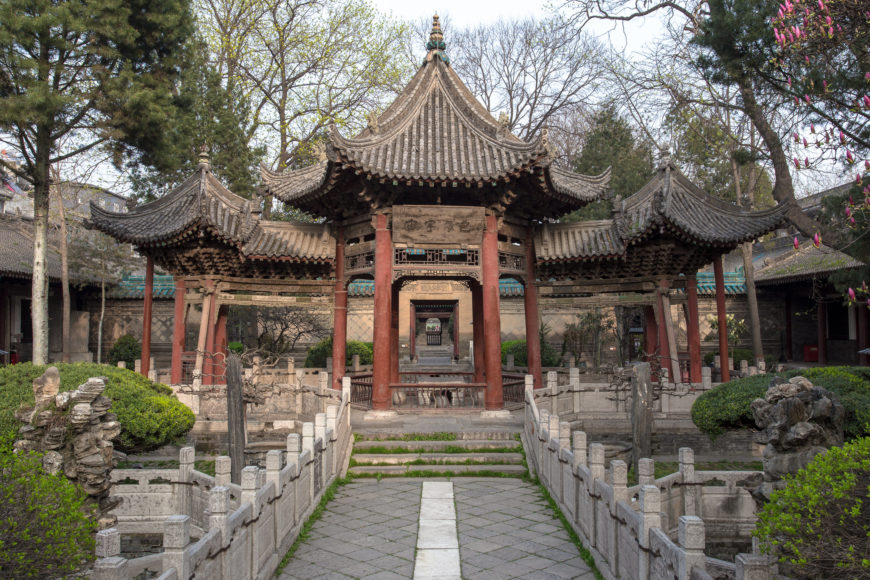
View of the Not bad Mosque of 11'an, Shaanxi, Prc (photo: Alex Berger, CC Past-NC 2.0)
Islamic art is not a monolithic style or movement; information technology spans ane,300 years of history and has incredible geographic diversity—Islamic empires and dynasties controlled territory from Spain to western China at diverse points in history. Nonetheless, few if whatever of these various countries or Muslim empires would have referred to their fine art as Islamic. An artisan in Damascus thought of his work as Syrian or Damascene—not as Islamic.
As a result of thinking about the problems of calling such art Islamic, sure scholars and major museums, similar the Metropolitan Museum of Art, have decided to omit the term Islamic when they renamed their new galleries of Islamic art. Instead, they are called "Galleries for the Art of the Arab Lands, Turkey, Iran, Central Asia, and Later Southern asia," thereby stressing the regional styles and individual cultures. Thus, when using the phrase, Islamic art, one should know that information technology is a useful, but artificial, concept.
In some ways, Islamic art is a bit like referring to the Italian Renaissance. During the Renaissance, there was no unified Italia; it was a land of contained metropolis-states. No one would take thought of one's self every bit an Italian, or of the art they produced as Italian, rather one conceived of one's self every bit a Roman, a Florentine, or a Venetian. Each metropolis adult a highly local, remarkable style. At the same time, there are certain underlying themes or similarities that unify the art and architecture of these cities and allow scholars to speak of an Italian Renaissance.
Themes
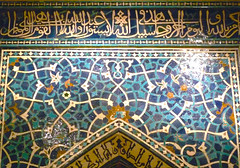
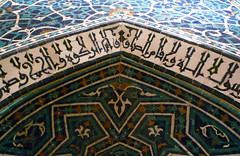
Similarly, there are themes and types of objects that link the arts of the Islamic Globe together. Calligraphy is a very important art form in the Islamic world. The Qur'an, written in elegant scripts, represents Allah's (or God's) divine word, which Muhammad received directly from Allah during his visions. Quranic verses, executed in calligraphy, are constitute on many different forms of art and architecture. Too, poetry tin can be plant on everything from ceramic bowls to the walls of houses. Calligraphy'southward omnipresence underscores the value that is placed on language, specifically Arabic.
Geometric and vegetative motifs are very popular throughout the lands where Islam was once or still is a major religion and cultural forcefulness, appearing in the individual palaces of buildings such equally the Alhambra (in Espana) as well equally in the detailed metal piece of work of Safavid Iran. Likewise, sure building types appear throughout the Muslim world: mosques with their minarets, mausolea, gardens, and madrasas (religious schools) are all common. However, their forms vary greatly.
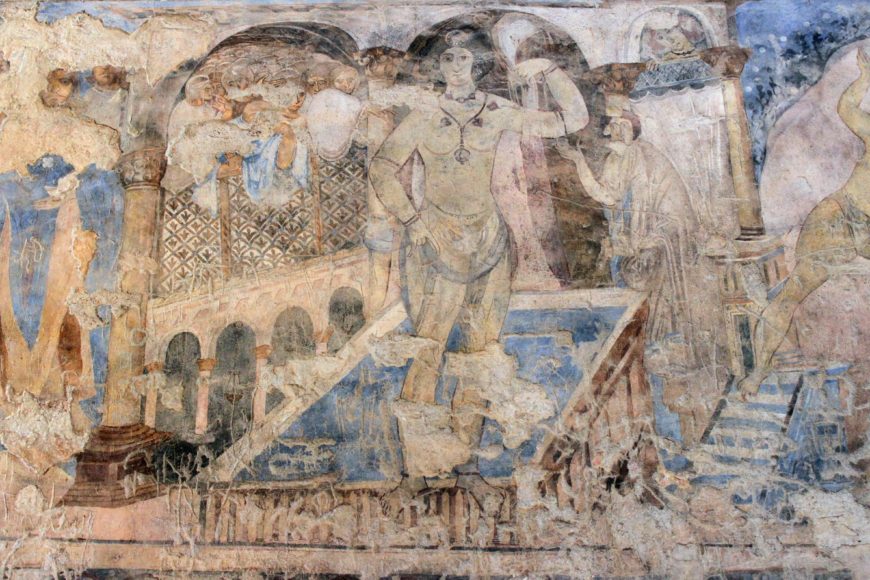
Bathing scene on west wall of due west alley of audience hall, Qasr 'Amra, c. 730, Jordan (photo: Sean Leatherbury/Manar al-Athar)
One of the nigh common misconceptions about the art of the Islamic world is that it is aniconic; that is, the fine art does not contain representations of humans or animals. Religious art and architecture, almost from the primeval examples, such as the Dome of the Rock, the Aqsa Mosque (both in Jerusalem), and the Great Mosque of Damascus, built under the Umayyad rulers, did not include human figures and animals. However, the private residences of sovereigns, such as Qasr 'Amra or Khirbat Mafjar, were filled with vast figurative paintings, mosaics, and sculpture.
The report of the arts of the Islamic world has besides lagged backside other fields in fine art history. At that place are several reasons for this. First, many scholars are non familiar with Standard arabic or Farsi (the ascendant language in Iran). Calligraphy, particularly Standard arabic calligraphy, as noted to a higher place, is a major art course and appears on nigh all types of architecture and arts. Second, the art forms and objects prized in the Islamic world practise not represent to those traditionally valued past art historians and collectors in the Western globe. The so-called decorative arts—carpets, ceramics, metalwork, and books—are types of art that Western scholars take traditionally valued less than painting and sculpture. Nevertheless, the terminal fifty years has seen a flourishing of scholarship on the arts of the Islamic world.
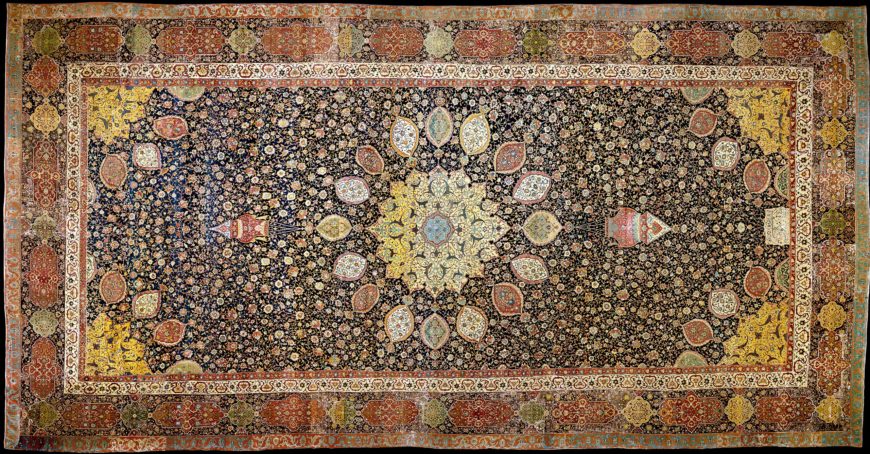
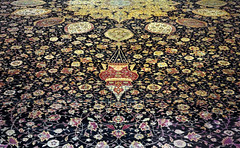
Medallion Rug, The Ardabil Carpet, unknown artist (Maqsud Kashani is named on the carpet's inscription), Persian: Safavid Dynasty, silk warps and wefts with wool pile (25 million knots, 340 per sq. inch), 1539–40 C.E., Tabriz, Kashan, Isfahan or Kirman, Iran (Virginia & Albert Museum, London)
Arts of the Islamic earth
Hither, nosotros have decided to use the phrase "arts of the Islamic world" to emphasize the art that was created in a globe where Islam was a dominant religion or a major cultural forcefulness, just was not necessarily religious art. Often when the word "Islamic" is used today, it is used to describe something religious; thus using the phrase, Islamic art, potentially implies, mistakenly, that all of this art is religious in nature. The phrase, "arts of the Islamic world," also acknowledges that non all of the work produced in the "Islamic globe" was for Muslims or was created by Muslims.
Notation on organisation from the contributing editor
We have organized the material in this section into three chronological periods: early, medieval and tardily. When starting to learn about a new surface area of art, chronological organization oftentimes enables students to grasp the textile and its fundamentals before going on to more than complex analysis, similar comparing building types or styles. Within each of these chronological groups, we have focused on creating geographic groups or groupings to organize the fabric further. The Islamic globe was only unified very briefly in its history nether the Umayyads (661–750 CE) and the early Abbasids (750–932 CE). Soon various dynasties or rulers simultaneously commanded sections of territory, many of which had no cultural commonalities, aside from their religion.
We are as well planning to upload a series of introductory essays on major types of art and architecture from the Islamic world, including carpets and mosques, in improver to essays and videos nigh specific works of art and architecture. These are forthcoming.
Arabic, Persian and Turkish are complex languages whose transcription from their respective scripts to English has changed considerably over time. For the sake of ease, we have used the most common forms today, omitting the vocalizations. While we have aimed for consistency, we have also tried to utilise the simplest forms for those who are new to the arts of the Islamic globe.
Boosted resources
Bloom, Jonathan, and Sheila Blair, Islamic Arts (London: Phaidon Press, 1997).
The Nature of Islamic Fine art on The Metropolitan Museum of Art'due south Heilbrunn Timeline of Art History.
Archnet, a resource focused on architecture, urbanism, environmental and landscape blueprint, visual culture, and conservation bug related to the Muslim world.
Islamic Art reading list from the Victoria and Albert Museum.
Smarthistory images for educational activity and learning:



More Smarthistory images…
Source: https://smarthistory.org/arts-of-the-islamic-world/
0 Response to "What Form of Art Can the Greatest Cultural Blending of the Muslim World Be Seen"
Post a Comment